
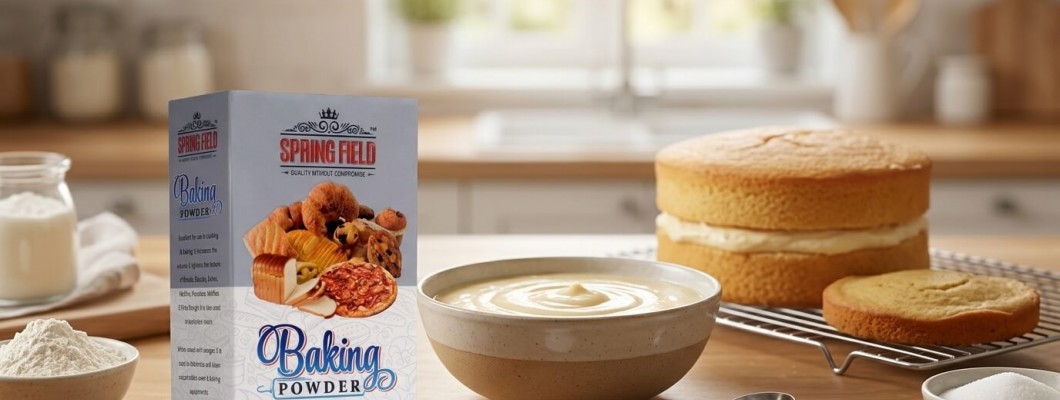
The Lift Behind Better Baking: Baking Powder Decoded
Quick Answer: Baking powder is a chemical leavener that helps cakes, muffins, pancakes, biscuits and other baked foods rise. Unlike baking soda, baking powder already contains both a base and acid-forming components, so it can produce carbon dioxide when activated with moisture and heat.
If your cake, muffin or pancake comes out flat and dense, the problem may not always be the flour or oven. The leavening ingredient also plays an important role. Baking powder is designed to create gas bubbles inside batter or dough, helping baked foods become lighter and higher.
Most supermarket baking powder is double-acting, meaning it reacts in more than one stage. The first reaction begins when the powder meets liquid, while another reaction occurs with heat during baking. King Arthur Baking explains this two-stage action and provides a simple freshness test.
What is baking powder?
Baking powder is a leavening mixture containing a bicarbonate base and acid-reacting ingredients, usually with a starch or other neutral material to help keep the powder stable.
When baking powder is activated, it produces carbon dioxide gas. Those gas bubbles expand during cooking and help create a lighter structure in the baked food.
The USDA Agricultural Marketing Service describes baking powders as available in single-acting and double-acting forms, with double-acting products using acids that react at different stages.
How does baking powder make cakes rise?
Baking powder creates carbon dioxide inside the batter. As the batter heats, the gas bubbles expand and help the mixture rise before the structure of the cake or baked food sets.
- Baking powder is mixed into the dry ingredients.
- Liquid is added to the batter or dough.
- The baking powder begins reacting.
- Carbon dioxide bubbles form inside the mixture.
- Heat in the oven or cooking surface helps expand the gas.
- The baked structure sets around those bubbles.
This is why baking powder is important in many quick baked foods where you want lift without relying on yeast fermentation.
What foods use baking powder?
| Food | Why baking powder is useful |
|---|---|
| Cakes | Helps create a lighter, higher crumb |
| Muffins | Supports rise and a lighter texture |
| Pancakes | Helps create a fluffy interior |
| Biscuits | Provides lift and tenderness |
| Scones | Helps produce a lighter baked texture |
| Quick breads | Provides chemical leavening without yeast |
What is the difference between baking powder and baking soda?
The simplest difference is this: baking soda is a base that needs an acidic ingredient to react, while baking powder contains both a bicarbonate base and acid-reacting ingredients.
| Feature | Baking Powder | Baking Soda |
|---|---|---|
| Contains an acid component | Yes | No |
| Needs an acidic ingredient in the recipe | Usually not for its basic leavening reaction | Yes |
| Main role | Lift and lightness | Leavening plus effects on spread, colour and flavour |
| Common uses | Cakes, muffins, pancakes, biscuits | Cookies, quick breads and recipes containing suitable acids |
| Typical supermarket form | Often double-acting | Sodium bicarbonate |
King Arthur Baking's baking soda and baking powder comparison explains that baking powder contains both the basic and acidic components needed for its leavening action, while baking soda requires an acidic partner.
Can baking powder replace baking soda?
Not automatically. Baking powder and baking soda are chemically different leaveners, so replacing one with the other can change the rise, flavour, colour and texture of a recipe.
If a recipe specifically calls for baking soda, check why it is being used before making a substitution. The recipe may depend on an acidic ingredient to activate the soda or to balance the flavour.
Why do some recipes use both baking powder and baking soda?
Some recipes need both because the two ingredients perform different jobs. Baking soda can react with acids in the recipe, while baking powder can provide additional leavening.
For example, a recipe may contain an acidic ingredient but not enough acidity for baking soda alone to provide all the desired lift. Baking powder can provide additional leavening support.
What does double-acting baking powder mean?
Double-acting baking powder is designed to react in two stages. Some gas production begins when the powder becomes wet, while additional leavening occurs when the batter is heated.
This gives the baker more leavening activity during the transition from mixing to baking. King Arthur Baking describes supermarket double-acting baking powder as reacting first with liquid and then again with oven heat.
When should you add baking powder?
Add baking powder according to the recipe's instructions, normally by mixing it thoroughly with the dry ingredients before combining the dry and wet ingredients.
Good distribution matters because the leavener needs to be spread throughout the batter or dough rather than concentrated in one area.
- Measure the required baking powder.
- Combine it evenly with the dry ingredients.
- Add the wet ingredients according to the recipe.
- Mix only as much as the recipe requires.
- Transfer the batter to the pan or cooking surface.
- Bake or cook according to the recipe instructions.
Why is my cake not rising even though I used baking powder?
A cake can remain flat for several reasons, including old baking powder, incorrect measurement, poor mixing, an unsuitable substitution or batter that sits too long before baking.
- Old baking powder: Its leavening power can decline with time.
- Incorrect quantity: Too little may not provide enough lift.
- Uneven mixing: The baking powder may not be distributed through the flour.
- Long delays: Some leavening activity begins once liquid is added.
- Incorrect substitution: Baking soda and baking powder are not interchangeable ingredient-for-ingredient.
- Recipe imbalance: Flour, liquid, fat, eggs and leavening all affect the final structure.
King Arthur Baking's baking trials found that longer batter resting can reduce the rise of cakes made with chemical leaveners, so once the batter is prepared, follow the recipe's timing rather than leaving it unattended for an unnecessarily long period.
How can you test whether baking powder is still active?
A quick kitchen test can help you check whether baking powder still produces a visible reaction.
- Place about 1/2 teaspoon of baking powder in a small bowl.
- Add about 2 tablespoons of warm water.
- Watch for bubbling and foaming.
- If there is little or no reaction, replace the baking powder.
This test is based on guidance from King Arthur Baking's freshness test.
How should baking powder be stored?
Keep baking powder tightly closed and store it in a cool, dry cupboard. Moisture can affect powdered leavening ingredients, so avoid leaving the container open or storing it beside a source of steam.
- Close the lid immediately after use.
- Keep the container dry.
- Store it away from direct heat and steam.
- Check the package date and storage instructions.
- Test older baking powder before relying on it for an important bake.
How much baking powder should you use?
There is no single amount that works for every recipe. The required quantity depends on the amount and type of flour, liquid, sugar, fat and other ingredients in the formula.
For consistent results, follow the recipe's specified measurement instead of adding extra baking powder simply because you want a taller cake.
Too much leavener can affect the taste and structure of a baked product, while too little may leave it dense.
Can too much baking powder ruin a cake?
Yes. More baking powder does not automatically mean a better rise.
Excessive leavening can produce an uneven structure and may affect flavour. The goal is to use the amount appropriate for the recipe rather than trying to maximise the amount of gas produced.
Which recipes are best for baking powder?
| Recipe type | Baking powder fit |
|---|---|
| Vanilla cake | Excellent |
| Chocolate cake | Often useful |
| Muffins | Excellent |
| Pancakes | Excellent |
| Biscuits | Excellent |
| Scones | Excellent |
| Yeast bread | Usually not the primary leavener |
Who should keep baking powder in the kitchen?
Baking powder is a useful pantry ingredient for home bakers, cake makers, people preparing pancakes and muffins, and anyone who makes quick breads or biscuits.
It is particularly useful when you want baked goods to rise without waiting for yeast fermentation.
What is the easiest baking powder mistake to avoid?
The simplest rule is: do not treat baking powder and baking soda as the same ingredient. Check the recipe, measure accurately and make sure the baking powder is fresh.
Also avoid leaving prepared batter sitting around unnecessarily. Once liquid reaches the leavening ingredients, the chemical reactions begin.
Frequently Asked Questions
What is baking powder?
Baking powder is a chemical leavening mixture that helps baked foods rise by producing carbon dioxide gas when activated.
What does baking powder do in a cake?
It helps produce gas bubbles that expand during baking, contributing to a lighter and higher cake structure.
Is baking powder the same as baking soda?
No. Baking powder contains both a bicarbonate base and acid-reacting ingredients, while baking soda is sodium bicarbonate and needs an acidic ingredient to react effectively.
Can I use baking powder instead of baking soda?
Not as a simple one-for-one substitution. The ingredients behave differently and can change the recipe's flavour, texture and rise.
Why is my baking powder not working?
It may have lost strength, especially if it has been stored for a long time or exposed to moisture. Test it with warm water before using it in an important recipe.
Does baking powder make pancakes fluffy?
Yes. Baking powder is commonly used as a leavener in pancakes and helps create a lighter, airier texture.
Can baking powder make cakes rise too much?
Using too much can create an uneven or unstable structure and may affect flavour. Follow the recipe measurement rather than adding extra.
What is double-acting baking powder?
Double-acting baking powder reacts in stages, with leavening activity beginning when it becomes wet and additional activity occurring during heating.
How do I know if baking powder is fresh?
Mix about 1/2 teaspoon with 2 tablespoons of warm water. Fresh baking powder should visibly bubble and foam.
Related TY Foods Resources
- Baking Ingredients Online in Pakistan
- Baking Soda Explained: Uses, Tips & Common Mistakes
- Instant Yeast for Naan, Bread & Pizza
- Cocoa Powder Uses for Cakes, Brownies & Desserts
- Icing Sugar for Frosting, Cakes, Cookies & Glazes
Key Takeaway
Baking powder is one of the key ingredients behind light, risen cakes, muffins, pancakes and biscuits. Use the quantity specified by the recipe, keep it dry and fresh, and remember that baking powder and baking soda are different leaveners.
Springfield is a brand by TY Foods Pakistan, offering practical baking ingredients for everyday home baking and kitchen use.
Further reading: King Arthur Baking: Baking Soda vs. Baking Powder, King Arthur Baking: Testing Baking Powder Freshness, and USDA Agricultural Marketing Service technical report.
Leave a Comment